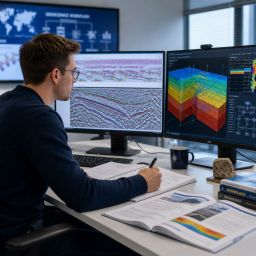
Seismic survey costs are often measured in terms of the cost per recording channel and with the ever-increasing requirement by oil companies to deploy more and more channels on the ground it is vitally important that technology is developed to meet this criterion.
Higher channel counts are required to acquire both more detailed and more target specific seismic data and high channel densification covering large areas is essential to acquire a comprehensive wide azimuth seismic dataset. Conventional cable based seismic acquisition systems manufactured by companies like Sercel have developed to a point now where their channel count is almost limitless.
Utilizing these systems with continually improving high-productivity Vibroseis shooting methods has enabled seismic acquisition contractors to offer clients step changing, cost effective and technically superior seismic acquisition products.

However, conventional cable acquisition systems do have limitations and cost constraints. The geometry of the field equipment layout is somewhat restricted by the cabling and as the channel count increases so does the size and cost of the seismic crew required to be operationally efficient.
The introduction of nodal recording systems over the past few years has been able to address both these limitations and in many experts opinion is the way forward for seismic acquisition. Nodal systems have few limitations with channel count and allow for a much more regular channel layout configuration on the ground which produces a more symmetrical and even azimuth distribution in the seismic dataset; beneficial to both seismic data processors and clients. Nodes also allow for localized irregular station geometry layout necessitated by poor access and obstacles.
Additionally the size of a nodal seismic crew, in terms of personnel and vehicles required, is significantly smaller than the equivalent conventional cable crew and thus financially more viable, particularly during downturns like we are currently experiencing.
Other technological changes are also being developed in the onward quest to streamline seismic acquisition even more. Although still in the early stages of development, it is anticipated that the introduction of drones for channel deployment and other tasks will further reduce seismic crew labour costs and improve acquisition efficiency.
Although new technology is crucial for the future of seismic, the health and safety of personnel working on seismic crews is even more important. Preserving the environment we live in for future generations is also vital.